
By Patrick Cahillane – Life, Executive & Business Coach with One Source International Coaching & Training and Founder of the One Source Personal Development Network
The Law of Averages
As agreed Gerry returned the following week and after catching up on a few things we turned
our attention to his personal development system.
‘Well, how did you do?’ I asked. Gerry reached in his case and produced his calendar. I was happy
to see that the entire week was completed, and Gerry seemed to be getting the hang of how the
system worked.
He replied by saying, ‘I had a few good days and a few not so good days as you can see’. I took a
moment to review his sheet before pulling out a blank sheet of paper and a pen. I then proceeded
to write the days of the week and the points he had given himself for that particular day.
Once I finished, I added up Gerry’s points and wrote the total under the days. The end result looked
something like this:
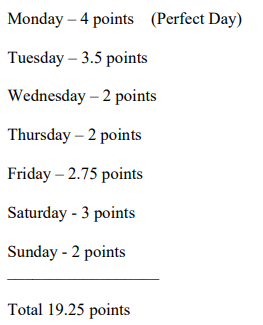
is the number of days Gerry had been using his system. Based on this calculation, Gerry’s average
for his first week was 2.75. Although Gerry was off to a good start, he missed his target of having
a successful week, which would have been a daily average of 3 points or higher per day.
When I explained this to Gerry, he seemed somewhat disappointed until I explained that he could
still make up the difference. You see, as I mentioned before, the system allows for error. Just
because you didn’t have a successful day or, in Gerry’s case, a successful week, it doesn’t mean
that you have failed. It just means that you need to try harder the next day, the next week, or even
the next month.
Let’s take a moment to take a closer look at Gerry’s first week of progress with using his system.
The first thing we need to take into consideration is that Gerry had an above-average week. Having
a daily average of 2.75 points is nothing to be disappointed about and is about as close as you can
get to having a successful week.
He should have been proud of himself. Keep in mind that this was only his first week and was a
big improvement from his previous behaviour. In the beginning it’s important to keep your
expectations realistic. Remember, most people overestimate what they can achieve in a month and
underestimate what they can achieve in a year.
Also, I pointed out that three days of his week he only received an average score of 2 points in total.
If Gerry had pushed himself just a little harder on those few days and increased his points just a
small bit and received 2.5 points, he would have improved his overall average and achieved his
weekly average of 3 points.
I pointed out that the difference between a successful week and an above average week was only a
small handful of actions and I was more than confident that in time Gerry would be achieving his
goal on a weekly, monthly and even a yearly basis.
I continued to explain to Gerry that if he was to push himself a little bit harder the upcoming week
and achieve a daily average of 3.25 points, the combined daily average for both weeks would
increase to 3 points per day.
‘Remember,’ I told him, ‘This is a long-term program. Success doesn’t happen in a day, and neither
does failure. Success happens over time by successfully taking the daily actions required to achieve
success.’
‘Think of it this way,’ I continued. ‘There are fifty-two weeks in a year. Let’s assume that half the
time, you are on track and achieve your goal of 3 points. Now let us take the human condition into
consideration and assume that sometimes you are going to make a mistake or lack the motivation
to achieve your goal for whatever reason. Let’s say about 25% of the time you only manage to
achieve a 2.50 points average. All you would need to do to achieve a yearly average of 3 points is
to average 3.50 points the remaining 25% of the time.
This is one of the secrets behind the system; it allows for what I refer to as the human condition.
We all make mistakes, and we will all experience times when we simply cannot motivate ourselves
to take action. No matter how hard we try and that’s okay.
The thing to understand is if you continue using the system no matter how bad you think you are
doing things will always average out. The reason for this is simply because if you are consistently
focusing on your results, you will begin linking pain to poor performance. This in turn will motivate
you to take positive action, which will make up for the times when the human condition comes into
play.
I believe this was the moment that Gerry really began to understand some of the power behind the
system.
‘I get it,’ Gerry began to explain. ‘It’s like last week, a couple of times I found myself getting upset
if I did something that I knew was going to cost me points. For example,’ he continued, ‘one of the
guys at the shop was about ten minutes late getting back from lunch and I completely overreacted.
Once I calmed down, I felt bad, but truthfully all I could think about was that I was not going to
receive my ¼ point. I was linking pain to my action. The funny thing is since then I noticed I really
try to keep myself from losing my cool.’
The two of us shared a slight laugh and it really pleased me to see that Gerry was beginning to
understand some of the power behind the system. ‘Let me ask you this,’ I said. ‘Have you noticed
it works the opposite way as well?’
Gerry’s reply did not take long. ‘Now that you mention it,’ he said, ‘I always feel great when I do
my light exercise in the morning because I know I have just earned ¼ point. The same thing goes
if I listen to something motivational or read because I know I’m earning my points.’
‘And what do you think that’s doing for you?’ I asked.
Gerry smiled and replied, ‘Linking pleasure to my actions.’ Once again, the two of us shared a brief
laugh.
I continued to explain that it’s hard to believe that a person can associate enough pleasure or pain
by using such a simple system that it will motivate them to take action, but it is true. All the system
is really doing is teaching you how to use pleasure and pain instead of having pleasure and pain use
you.
In some ways the system is similar to using a ‘To Do’ list but far more powerful. It is a known fact
that people who use a daily to-do list link pleasure to ticking off items that they have completed
and pain to uncompleted items. The difference between the system and a ‘To Do’ list is that the
system takes things to the next level by including your average and keeping you focused on the key
areas of your life and not just your daily tasks.
Imagine the satisfaction you will receive from the knowledge that you have had a successful week,
month or even a successful year. It is a great feeling to be certain that your life is on track, and you
truly are successful.
Next, I turned to the subject of how you determine if you are successful or not by asking Gerry the
following questions:
‘Do you currently consider yourself to be successful? If so, how do you determine that you are?
What is success anyway?’
I could see that Gerry was not quite sure exactly how to answer so I went on to explain that, in my
opinion, success is nothing more than a feeling or a state of mind. Basically, success is an emotion.
Most likely, you determine if you are successful or not by a set of rules you have set up for yourself.
We all have rules internally that we must fulfil in order to feel any emotion, even success.
That is all success really is, a feeling. More specifically success is a feeling or an emotion we reward
ourselves with whenever or if ever we fulfil all the rules required in order to be successful.
But the interesting thing is we are the ones who make the rules. We decide what must and what
must not happen in order to experience the emotion of success.
The problem is that the majority of us set up the rules completely wrong. We make the mistake of
making them so hard to achieve that we rarely or never get the pleasure of experiencing the emotion
that we desire.
Even if we do, it is normally short-lived because we convince ourselves that we do not really
deserve to feel this way or that we are just faking it.
This is another one of the little secrets behind our system, I continued. We are setting achievable
rules (action items) that we must achieve before giving ourselves permission to experience a certain
emotion.
For example, if we achieve 3 points at the end of the day, we give ourselves permission to feel as
if it has been a successful day. Or if we achieve 4 points, we give ourselves permission to feel as if
it’s been a very successful day.
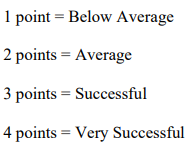
I took a moment to remind Gerry of what the points represent, as seen in the chart below. I also
explained that it is possible to have an average that falls somewhere in-between these points, such
as 1.5 points or 3.25 points, and advised him to determine what these numbers represent based on his own standards.
convincing yourself that you really do deserve to feel the emotion of success.
After all, you know you have fulfilled all the rules required because you created them and know
exactly what they are. This provides you with absolute internal certainty that you deserve to feel
successful, which in turn will make you more confident and produce even greater results.
This is known as validating your beliefs, which plays a critical role in how you act or react in
various situations.
I explained the importance of validating your beliefs to Gerry and was impressed that he already
had a good understanding of the principle.
‘It’s kind of like sports’ he replied. ‘The more a team wins, the more confident they become. The
more confident they become, the more matches they win. The bookies even factor this in when
calculating the odds.’ Even though I’m not what you would call a betting man, I appreciated the
analogy and was delighted that Gerry had a general understanding.
‘Tell me this,’ Gerry continued. ‘As I gain momentum and begin growing stronger, do I run the
risk of losing my edge because obtaining an average of 3 points is no longer a challenge?’
I took a moment to think before replying, ‘what would you do if you decided to start training to
run a marathon? Would you start out running twenty-six miles?’ Gerry laughed and simply replied,
‘If I decided to start training for a marathon in my current condition, I’d be lucky to start out running
a quarter-mile.’
‘That’s the point,’ I replied. ‘You would start out by running what you were capable of running,
however, as time passed you would increase your distance bit by bit until you felt you were fit
enough to run the twenty-six miles. Next you might decide to work on improving your time by
gradually increasing your pace. The system is similar. You start out doing what you’re capable of
doing and as you grow stronger, you increase your action items. You are constantly pushing
yourself harder, so obtaining an average of 3 points is always a challenge.’
‘Allow me to give you an example,’ I continued. ‘Let’s take a look at your key area of Health and
Fitness. Currently you reward yourself with a ¼ point if you don’t smoke over 15 cigarettes per
day. The reason for this is because previously, you were smoking over 20 cigarettes per day. As
you grow stronger, I would suggest you might consider changing that to say 10 cigarettes per day.
Or instead of rewarding yourself with a ¼ point for light exercise, you might consider changing
that to light exercise and say a 30-minute walk.’
Gerry indicated he understood by asking what I considered to be an intelligent question. ‘Would it
not be easier to just strive to get an average of 4 points instead of only 3 points?’
I explain to Gerry that the fourth point in the system is there to allow you to make up for days that
you failed in your efforts to secure 3 points or whatever goal you have set for yourself. Simply put,
if your goal was to average 4 points and the most you could reward yourself within any one day is
4 points, the first bad day you had would make it impossible to make up your average. You would
be setting yourself up for failure.
Gerry and I continued our conversation for some time until I was confident that he completely
understood the importance of calculating his average and adjusting his action items as he grows
stronger. I next turned our attention to the importance of adjusting his system depending on his
schedule and day of the week.
It is important to keep in mind that there will be days or even weeks that you will not be in a position
to complete your action items. For example, most individuals do not work on a Sunday, so it would
make it difficult to earn points for your business or career action items. Or say you had a family
vacation; this is definitely a time you should not be thinking about your career or business and most
likely may affect some of the other key areas as well.
In Gerry’s case, his business was not open on a Sunday. He normally saw Sunday as not only a day
of rest but a day of recovery. The reason for his recovery was because he generally would have a
few too many drinks on Saturday night. His standard routine would be to sleep until 11:00 a.m.
then stumble to the kitchen for something to eat before flopping out on the couch to watch TV until
dinner was ready. After dinner he would return to his couch until he eventually had enough strength
to drag himself into the shower, get cleaned up and head back to the pub to meet up with a few
friends. Not exactly what you would call a productive day.
After taking some time to review his actions, Gerry came up with the following action items and
point values for what he refers to as his Sunday business and finances key area:
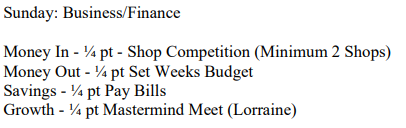
Gerry went on to explain why he felt these new actions were going to be so beneficial to both him
and his family. Normally, Sunday is a wasted day in my week. Lorraine usually gets fed up looking
at me lying on the couch. I accomplish nothing in the home or for the business, and I usually end
up spending money at the pub that we really can’t afford.’
I could see by Gerry’s expression and the tone in which he spoke that he genuinely was
disappointed and somewhat embarrassed by his previous behaviour. However, when he began to
speak about his new action items, his entire demeanour changed, and he became quite excited.
‘Now,’ Gerry continued, ‘I’m going to get up early and drive down to the shopping mall and check
out some of my competitors. This is something I used to really enjoy doing, however, over the last
couple of years I just fell out of the habit. Not only will this be good for my business because I’ll
come up with new ideas and keep tabs on what they are doing; but I also plan on bringing my son
with me.’
‘He used to really enjoy going with me before, and it will give us a chance to spend some father
and son time together. If we plan it right, we can get up early and be back just in time to have
breakfast with Lorraine and the girls.’
‘After breakfast I’ll head upstairs to my study for an hour or so to sort out the bills for both the
home and the business. I usually do this at work, but it is so hard to focus because of the
interruptions. I know that I’m not reviewing my bills properly and I could be paying for items or
services I didn’t receive or just don’t need.’
‘Also, once I pay the bills, I will be in a much better position of setting my weekly budget. I
normally don’t do this and have no idea of how much I spend on a daily or weekly basis.’
‘However, the action I am most looking forward to is my mastermind meetings with Lorraine. This
is something we used to do when we first got married, and I truthfully don’t know why we stopped.
What we will do is go out Sunday evening for a cup of coffee and maybe a slice of pie. We will
chat about everything that happened over the previous week and what’s coming up in the current
week. But the best part,’ Gerry continued, ‘is we will do what we used to call dream build. We will
talk about our goals and plan on how we can achieve them.’
When Gerry finished speaking, I was more than confident he was in the process of changing the
direction of his life. It is important to understand that every action we take is a cause set in motion
or another way of thinking of it is for every action, there is a reaction. For example, investing the
time to learn the system is a cause set in motion. Making the decision not to apply what you learn
is a cause set in motion.
The thing to keep in mind is that every action we take, no matter how big or how small, stacks up
on the previous action, which is ultimately moving us in a certain direction. If we are not careful
and don’t pay attention to our actions, we could easily end up somewhere that we don’t want to be.
**NOTE – If you would like to use our FREE online calendar for tracking your progress or
what we refer to as your dashboard, please visit www.onesourcedashboard.com .